Capacitance Converter
IEC 60062 104 is 100 nF (0.1 µF).
Calculator
Formula
3-digit code (pF)
C(pF) = (d1 d2) × 10^m (m = 8 → ×0.01, m = 9 → ×0.1) Variables
| Symbol | Meaning | Unit | Typical range | Precision | Default |
|---|---|---|---|---|---|
| code | Marking | — | — | 4 sig | 104 |
| C | Capacitance (optional, instead of code) | F | — | 4 sig | |
| pF | Picofarads | pF | — | 4 dp | — |
| nF | Nanofarads | nF | — | 4 dp | — |
| µF | Microfarads | µF | — | 4 dp | — |
| mF | Millifarads | mF | — | 4 dp | — |
Worked example
Code 104 = 100 nF
| Input | Value |
|---|---|
| code · Marking | 104 |
| Output | Value |
|---|---|
| pF · Picofarads | 100000 pF |
| nF · Nanofarads | 100 nF |
| µF · Microfarads | 0.1 µF |
| mF · Millifarads | 0.0001 mF |
1R5 = 1.5 pF
| Input | Value |
|---|---|
| code · Marking | 1R5 |
| Output | Value |
|---|---|
| pF · Picofarads | 1.5 pF |
109 = 1.0 pF
| Input | Value |
|---|---|
| code · Marking | 109 |
| Output | Value |
|---|---|
| pF · Picofarads | 1 pF |
100 nF encodes as 104
| Input | Value |
|---|---|
| C · Capacitance (optional, instead of code) | 100 nF |
| Output | Value |
|---|---|
| code · Marking | 104 |
| nF · Nanofarads | 100 nF |
How it works
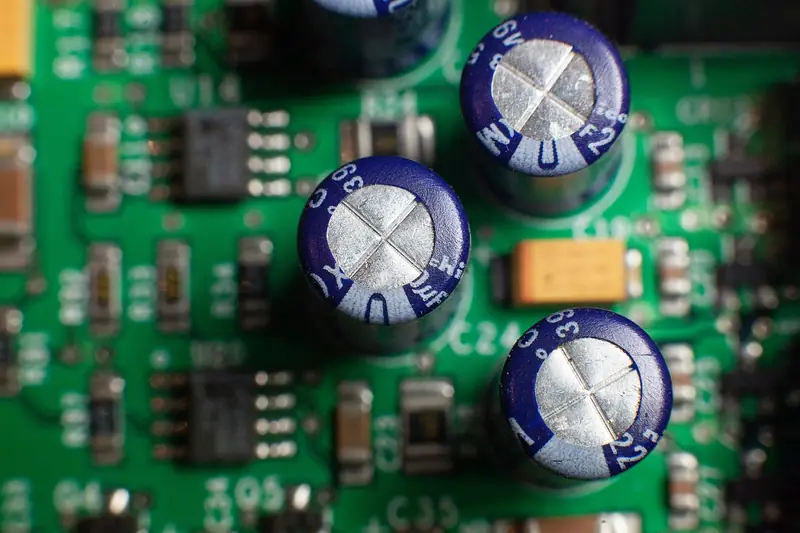
Ceramic capacitors print a three-digit code that looks like a resistor code but is always in picofarads. 104 is the 100 nF decoupler on almost every board; 109 is a 1 pF trick that catches people out.
Decode a marking or encode a farad value. The SI columns keep pF, nF, µF, mF and F in view so a SPICE netlist and a BOM stay consistent.
Pitfalls
- Reading a capacitor 104 as 104 pF. It is 10 × 10⁴ pF = 100 nF.
- Third digits 6 and 7 are not defined for capacitance codes.
- A trailing letter (104K) is tolerance, not part of the value.
FAQ
What is a 104 capacitor?
100 nF. Two significant digits 10, multiplier 10⁴ pF.
What does 1R5 mean?
1.5 pF. R is the decimal point.
Why is 1 pF marked 109?
Third digit 9 means ×0.1, so 10 × 0.1 = 1 pF.
Can I encode from a value?
Yes. Switch to “from value”. Non-E12 figures round to the nearest 2-significant-digit code.
Related
Sources
- IEC 60062 marking codes for resistors and capacitors (IEC 60062) · retrieved